Pensions in Space
Are passive investors really so passive? And what role does pension money play in turning overhyped private companies into overhyped public ones?



These days, everyone is weighing in on the SpaceX IPO. What we do not often see, though, is a joint letter from three of the biggest U.S. pension funds stepping in, seemingly trying to prevent it. Also unprecedented are the new fast-entry index rules, which could help inflate SpaceX’s stock price even further. Because of all this, the pre-IPO conversation has shifted away from the “active” money of hedgers, short sellers, skeptics, and believers, and toward the “passive” money of ordinary people’s retirement savings.
On the surface, it is the Ontario Teachers’ Pension Plan that may win big from the SpaceX IPO. What is hidden, on the other hand, is that a much bigger shift in the U.S. pension economy has been happening for a while, creating a liability for the U.S. economy overall. And the SpaceX IPO may become a trigger for a huge swing in retirement money — one that the interested parties may fail to notice in time.
IPO in the fast lane
SpaceX’s IPO is scheduled for Friday, June 12. The company will list its stock on the Nasdaq exchange under the ticker SPCX. It will be priced at $135 per share, giving SpaceX an initial market capitalization of $1.77 trillion. But that figure could be much larger by the time the market closes. Less than 5% of SpaceX stock will become available to the public and everything seems to be set up to make the public fight for it even without wanting to.
SpaceX is losing billions, and its market capitalization is highly contested. However, ahead of the IPO, Wall Street tossed guardrails created to protect investors in order to fast track the company into index funds, and people’s retirement savings. Two of the four largest index providers have already created new fast-entry rules and relaxed financial viability requirements in order to accommodate upcoming mega-IPOs, such as SpaceX and Anthropic (more on that later), in major indexes quicker than ever before. Nasdaq and FTSE Russell are cutting their timeframes for inclusion from three months to five and 15 days. Once it happens, passive index funds where the majority of retirement savings are stored will not have a choice, and would have to invest nonetheless. “A diversified index is the most cost-effective way to minimize risk <...> We wouldn’t directly participate in an IPO, but we will have exposure once it is added to the index”, a spokesperson for CalSTRS says in an interview to Pensions & Investments.
The Great Retirement Money Machine
The amount of forced passive buying expected to flow into SpaceX stock is estimated at $14 billion to $20 billion. That is a substantial share of the available float (depending on the day-five price) and it will clearly boost SpaceX’s market capitalization. But on the larger scale of retirement money, it is almost nothing.
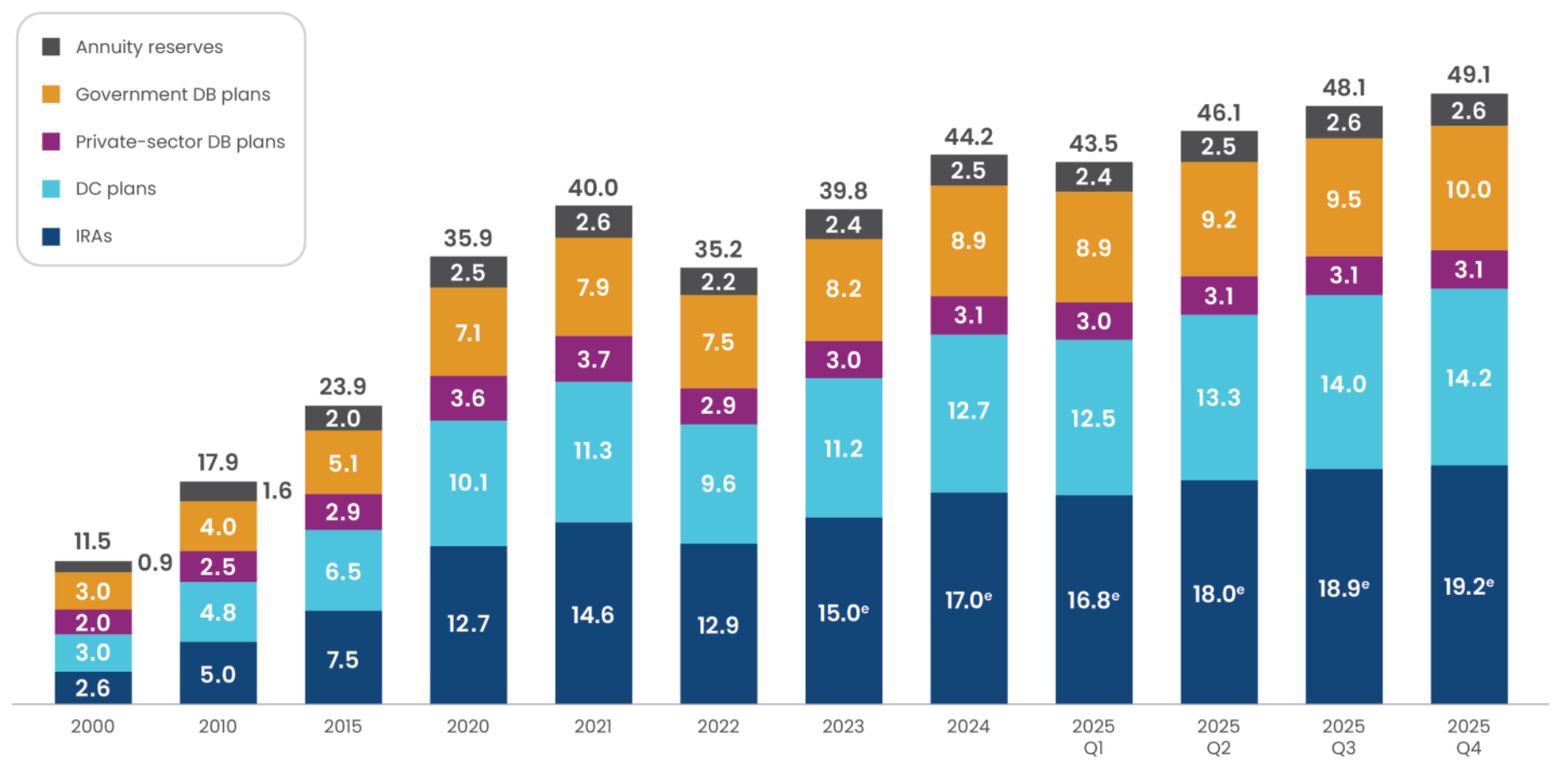
Total US retirement assets were $49.1 trillion as of December 31, 2025. For comparison, the entire U.S. public equities market has just reached an all-time high of $69 trillion. If we add U.S. national debt, we can see that retirement money owns roughly half of all U.S. public companies and half of U.S. debt.
This money is not entirely passive, either. Only about two-thirds of the $49.1 trillion in U.S. retirement assets are held in retirement savings accounts such as IRAs or in defined-contribution plans such as 401(k)s. These accounts are indeed largely limited to public equities (mostly through index funds, and mostly in large-cap companies) and bonds.
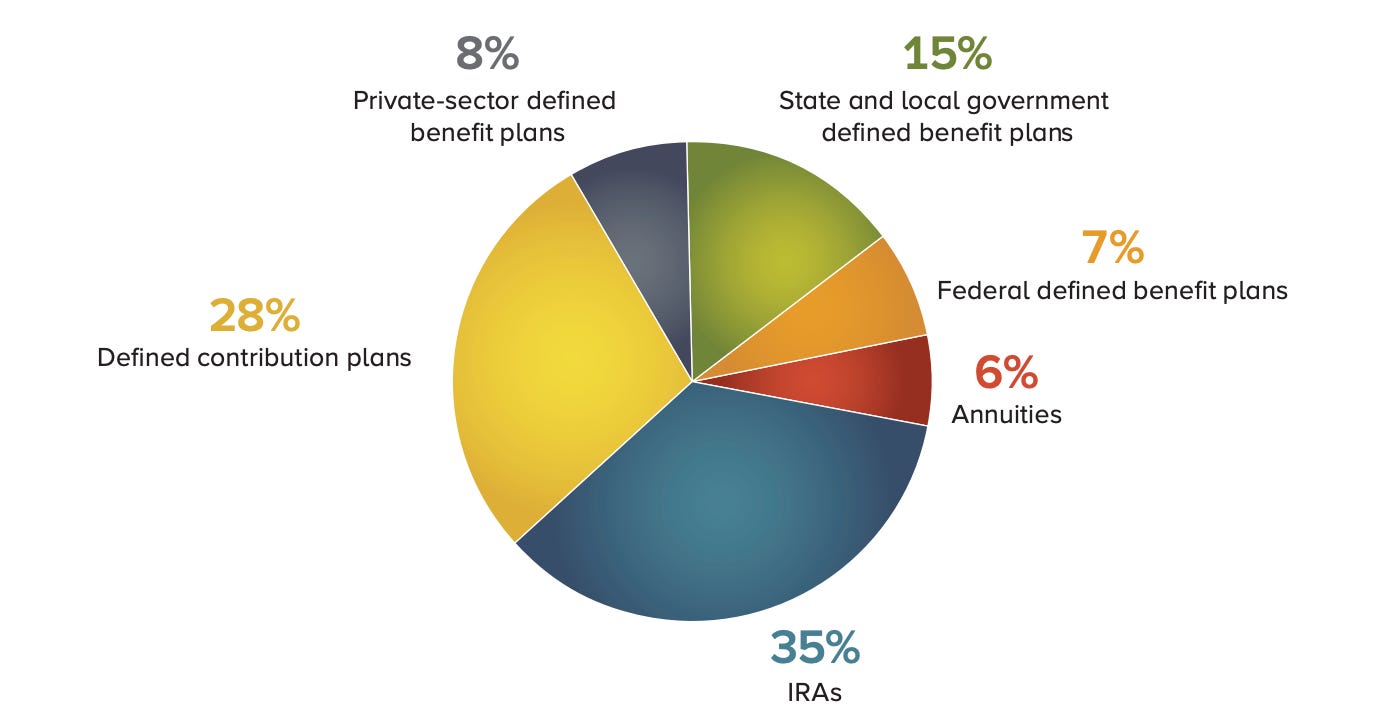
About 63 million workers, or roughly 50% of the entire U.S. private-sector full- and part-time workforce, are enrolled in defined-contribution plans. Through index funds, many of them will effectively become holders of SpaceX stock. And let’s not forget that they probably already have indirect exposure to SpaceX through their investments in Alphabet, whose venture arm Google Ventures owns a 7% pre-IPO stake in the company (and maybe even more direct through Fidelity Contrafund or other Fidelity mutual funds on the captable.)
All of this happens passively, and, more importantly, without a fiduciary responsibility for guaranteeing the safety of the money. Defined-contribution plans do not provide a guaranteed pension or a guaranteed return on investment.
So what about the other third, or roughly $18 trillion? In the U.S., a “pension fund” is an organization that manages money for workers enrolled in a defined-benefit plan. These plans provide guaranteed pension payments regardless of the performance of the pension fund itself. They remain the primary form of retirement plan for government employees, with nearly universal enrollment, while the private sector has largely stopped enrolling new workers in defined-benefit plans — though the assets in those plans have continued to grow.
Pension funds and riskier bets
New York City Comptroller Mark Levine, managing a combined $1 trillion in assets have made a joint letter addressing SpaceX and raising concerns about “perpetual super voting shares”, a CEO removal restriction (requiring CEO’s own consent) and many more. Now why would three of the biggest asset managers in the US break silence and escalate the matter? A previous encounter of a similar volume was back in 2017 prefacing Snap’s March 2017 IPO, almost 10 years ago. Snap pioneered the practice of giving zero voting rights to publicly traded shares. The market largest investors were not pleased.
Although the letters made no difference, either 10 years ago or now, they still serve as an important declaration, and probably as a safeguard for fund managers. Pension funds care less about early index-trading exposure than about the long-term future of an asset. Their mandate is much broader than that of a 401(k) account provider.
The bigger picture is that SpaceX can also be considered an AI company as of recent, adding to the long list of AI companies funded by US pension funds. SpaceX acquired xAI in February, the artificial intelligence company behind Grok and also owned by Musk, and, actually, the combined entity is seeking money in the public market. Which is also a concern because it shows even a bigger exposure.
Switching the spotlight to Anthropic and to the specific case. One of Anthropic’s earliest and most successful venture capital backers is Spark Capital (recently included in Forbes’ Midas list of exceptionally successful investors), leading the company’s Series C $450 million in total with $75 million funding back in May 2023. Today the company is valued at $965 billion, and Spark Capital’s bet is standing at a whopping $3 billion. Now, we’re looking into pension scheme exposure, why should we be concerned about the VC fund? It’s all in the headlines, where the Spark Capital money is coming from.
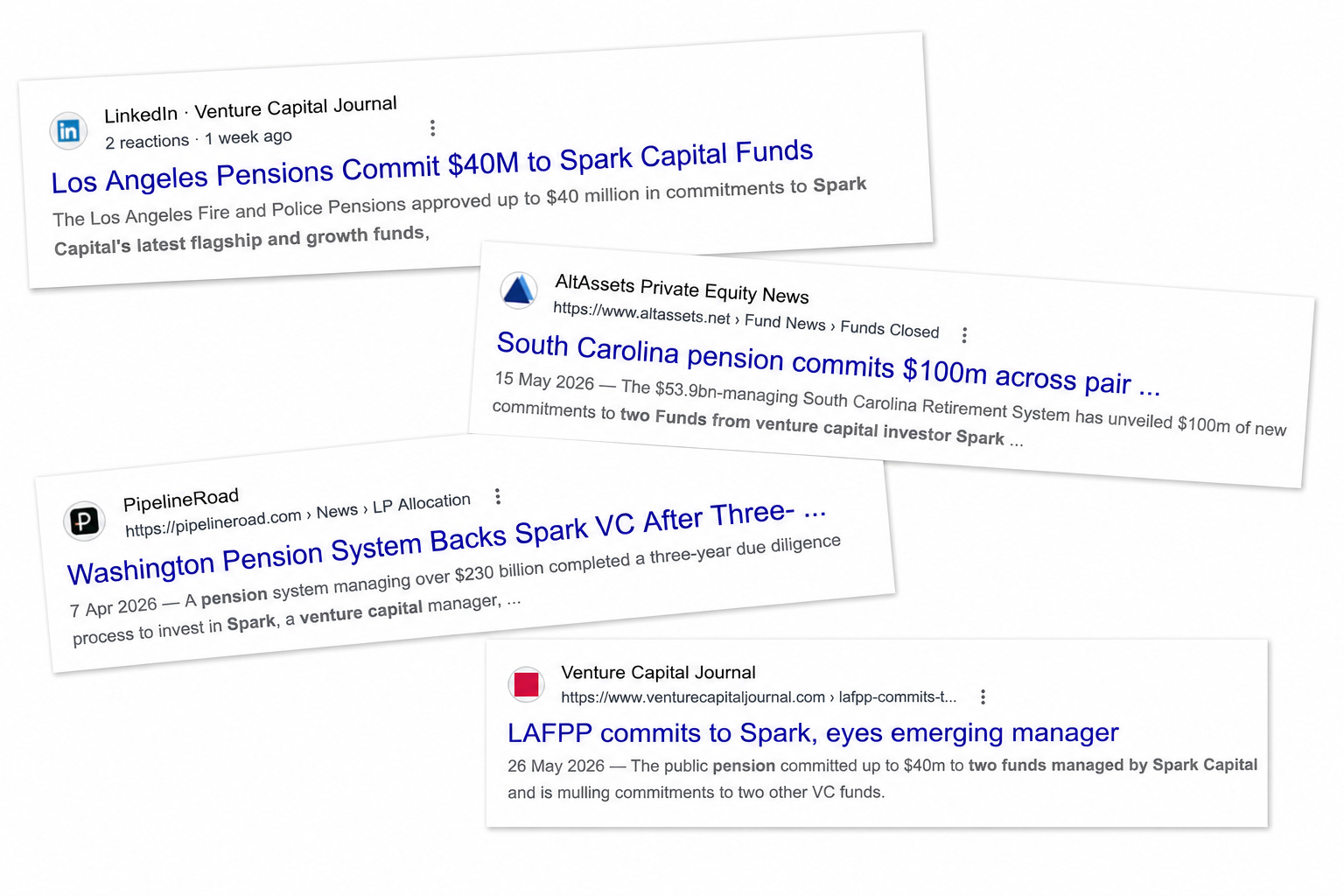
So, while SpaceX’s IPO is making huge ripples to the market by removing the guardrails with the help of Wall Street and getting a huge bet of pension money even incentivising the biggest asset managers to step up, the real story is happening beneath. And it’s that the exposure of pension money is bigger that we may see. Stakes in IPO assets can be tracked while stakes in private companies and funds can’t. And in the last decade pension funds started putting more money into high-risk investments which is venture capital by definition.
Some of the biggest venture investors to SpaceX are pension backed. Valor Equity Partners manage funds on behalf of many public employee retirement plans including CalPERS, CalSTRS, NYSTRS, NYCERS and others, while their founder Antonio Gracias has served on the boards of Tesla and SpaceX. Sequoia entered SpaceX during the 2021 Series J round through vehicles where the public pension LPs sit: Washington State’s up-to-$350M commitment to Global Growth Fund III was the first public pension commitment to a Sequoia fund, with Alaska Permanent Fund also among of its 19 LPs. And taking pension money for venture funding is becoming more and more trendy with investors. CalPERS invested in a16z for the first time in 2023, at the same time the fund invested $750 million in SpaceX.
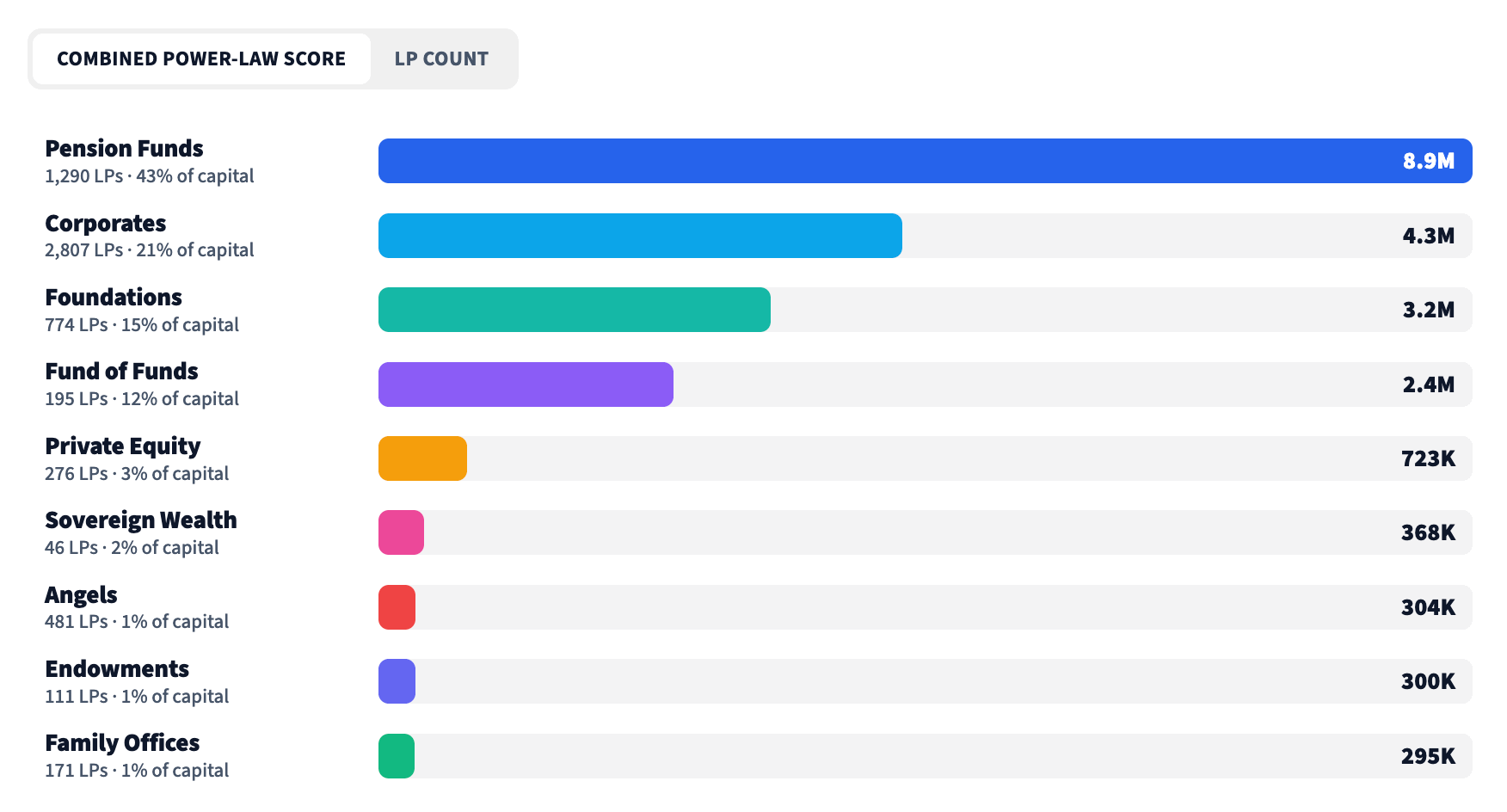
In the recent years CalPERS and other public pension funds directed the money flow into private equity, hedge funds, and venture capital. According to Stanford study, between 2001 and 2021, allocations to alternative assets went from 14% of pensions’ “risky” investments to 39%. By Dealroom data, pension funds provide more capital to top-performing VCs than any other LP class.
The Great Consequences
So, whether the population wants it or not, they are funding private companies, including ones in the AI niche that might as well replace their work position. Fair trade? They’ll get the profit if AI companies continue to grow, after all.
“The workers facing the greatest risk of displacement from AI automation <...> are disproportionately the workers who depend most on 401(k)s,” writes Hera Hiyeonseo Lee of Binghamton University in her article “Your 401(k) Is Propping Up the AI Bubble.” The ten largest companies in the S&P 500 now account for 40% of the entire index’s weight, while being AI-adjacent. That figure has doubled over the past 10 years, yet most employees enrolled in retirement plans may not be aware of the change. As Lee notes in her article: “A municipal employee in Texas who <...> has a substantial portion of her retirement riding on whether Nvidia’s data center revenue keeps growing. She did not choose this exposure.”
Who would pay the difference if pension money starts to lose value? One example, cited by Edward Siedle in his Pension Warriors newsletter, is that in 2021, 100,000 public school employees had to pay more into their retirement system because of accounting issues and the pension fund’s performance data. “Risky” investments made by pension funds are already being targeted for poor performance, as was recently seen in the House Republicans’ probe of CalPERS:
On October 28, the Committee learned that CalPERS lost 71 percent of its nearly half-a-billion-dollar investment in the private-equity CalPERS Clean Energy and Technology Fund, or CETF. Since committing to CETF in 2007, CalPERS has channeled more than $468 million into the fund. As of March 31, 2025, the investment’s value was less than $138.1 million.
Even worse, questionable stakes can also affect associated municipal bonds, since poor investment decisions create repayment risk for investors in those bonds.
So, while SpaceX’s IPO has already managed to draw attention to pension assets and their management, June 12, the date of the IPO, may become a turning point for the future policy of retirement funds. What we see right now is that pension money flows into high-risk venture investments that rely on industrial momentum rather than social need. Then, when those ventures go public, the same pension money helps inflate their valuations. Yet there is an abundance of initiatives that pension money could support instead.
There are multiple authors that follow the pension matters closely which would help you to get more informed about asset management and how it should be changed.
Hanno Lustig in his The Two Cents newsletter shares a model based on Norway pension fund, that shows a better way of retirement asset management.

Unpresidented, independent news organization, make a claim that retirement accounts are essentially a bail out for SpaceX purposes.

Caleb Ecarma recently touched on the topic of how the retirement savings would make Elon Musk a trillionaire while setting all the employees even further in terms of wealth.

 | A guest post by
|